
To close National Rivers Month, GPD is spotlighting several restoration projects—efforts that replaced short‑term repairs with long‑range, adaptive recovery strategies.
GPD has completed more than 65 ecological restoration projects, including 16+ dam removals and 72,659 linear feet of stream restoration. Signature initiatives—such as West Creek Restoration and Bank Stabilization, The Mahoning River Dam Removals and Restoration and Brightwood Dam Removal—continue to show strong post‑monitoring results, reinforcing the value of comprehensive restoration.
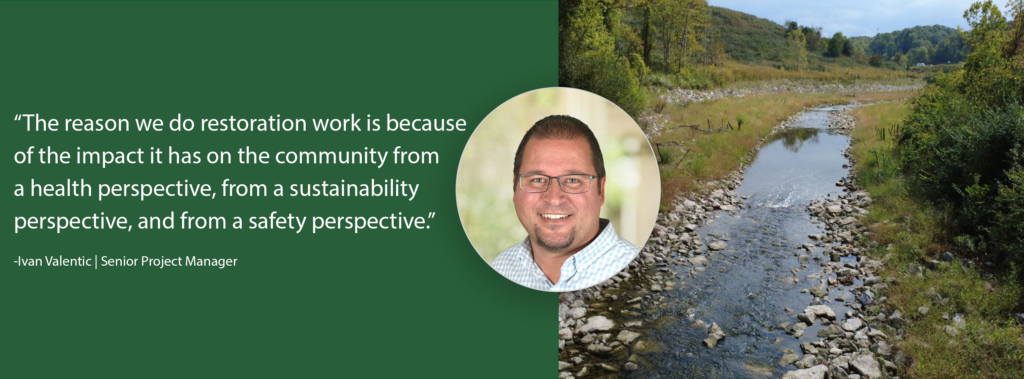
West Creek Restoration and Bank Stabilization
Prior to GPD’s involvement in 2018, West Creek Restoration and Bank Stabilization had been addressed in three separate piecemeal efforts, each focusing on roughly 1,000 linear feet at a time. Decades of interstate expansion, infrastructure development, and “band‑aid” fixes had dramatically transformed not only the creek’s shape, but its function.
Joe Lanni, a Project Manager at GPD Group, said the team approached the project with a holistic mindset—looking at the issues affecting the entire system. The effort, which encompassed roughly 6,500 linear feet, tackled exposed bedrock, bank erosion, channel incision, a confined valley, and failing stabilization measures. With this, a primary goal of the project was to remove all fish passage barriers.
To restore the creek’s function, the team implemented a raised‑grade design that created a more stable longitudinal profile, expanded flood‑prone areas, dispersed energy, and improved aquatic connectivity. Key components of the project included a 3.55‑acre floodplain expansion, 4,000 linear feet of bank stabilization, and the removal of a 420‑foot concrete flume. Additionally, the project restored the creek’s morphology through a channel redesign—stabilizing the movement of the creek and improving its ecological function.
After two years of post‑monitoring, the project has shown reductions in flow velocities and shear stresses. With this, six new fish species—including the endangered Ohio darter—have been observed, signaling a remarkable ecological recovery.
West Creek is now functioning as a more resilient waterway—one capable of supporting stronger habitats. These results underscore the long‑term value of restoration.
The Mahoning River Dam Removals and Restoration
The Mahoning River corridor is another example of our work in action, as a series of dam removals have helped reconnect miles of previously fragmented river. The corridor’s restoration advanced through a sequence of low‑head dam removals. Among the work was sediment management, riffle-pool reconstruction, sediment dredging, and riverbank stabilization. Across Struthers, Lowellville, Warren, and Leavittsburg, more than four miles of the Mahoning River has been re-established as a free‑flowing system, improving water quality, restoring sediment transport, and enhancing aquatic habitats. Collectively, the work demonstrates how targeted dam removal can accelerate ecological recovery and provide safer recreational passage.
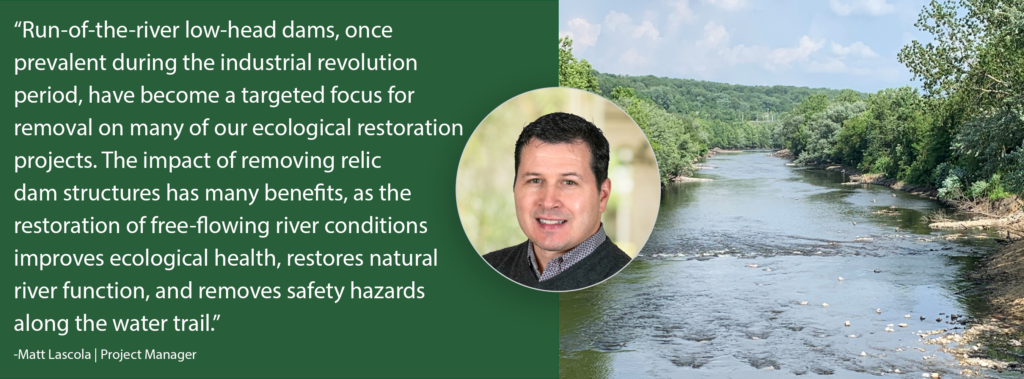
Projects like this illustrate why outdated dams have become such a priority in modern restoration efforts.
Brightwood Dam Removal and Kellogg Creek Restoration
The Brightwood Dam Removal project ultimately achieved similar success after GPD invested significant effort into public outreach. Lanni noted that many residents were initially threatened by the removal as it offered recreational opportunities and scenic views.
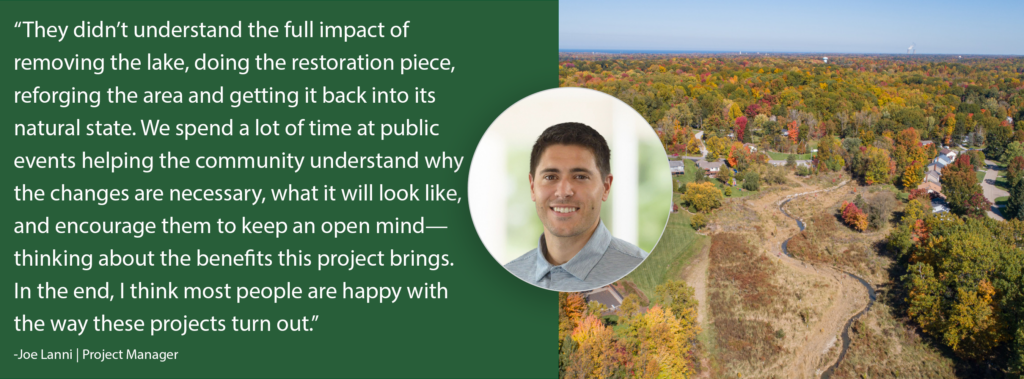
The Class I dam—seated at the highest level of risk—was fully removed, allowing Kellogg Creek to be restored to a natural, free flowing stream. The completed project went on to improve water quality, and therefore, positively impact fish passage and aquatic habitats.


Before and After Temporary/Controlled Dam Breach


Design-Build Partnership
Mahoning River and Brightwood were delivered through GPD’s design‑build partnership, which integrates designers, contractors, and environmental specialists into a single collaborative team. GPD, RiverReach Construction and EnviroScience, Inc. collaborate as one unit—demonstrating how engineering and environmental science can work in tandem for ecological improvement.
“Bringing the diverse knowledge of all disciplines together at the earliest level for the design build process through the construction phase is a much better approach than the traditional design bid build process,” said Shannon Carneal, principal for RiverReach Construction. “This is especially true when talking about stream restoration as the stream is always changing and evolving and projects are often implemented after field conditions have changed dramatically.”
As we celebrate National River Month, these achievements remind us that restoration doesn’t just repair rivers—it gives them the conditions they need to heal themselves. To learn more about GPD’s restoration services, reach out to, Jim Hewitt, Director of Water and Parks.